Blog
Are Peptides Steroids? Peptides vs. Steroids Explained

Disclaimer: This article is general information, not medical advice.
No, peptides are not steroids. They’re completely different types of molecules that work in different ways. But they often get lumped together because both are used for recovery, muscle and performance, and some peptides are banned in sport just like steroids.
Here’s the difference.
What are peptides?
Peptides are short chains of amino acids, the building blocks of protein. Typically they contain about 2 to 50 amino acids. Your body makes thousands of peptides, including insulin and many hormones.
Most peptides work as messengers. They bind to receptors on cells and signal them to do something, like release growth hormone, reduce appetite or start repairing tissue.
Examples: insulin, semaglutide, BPC-157, ipamorelin, collagen peptides.
What are steroids?
Steroids are lipid (fat-based) molecules built on a four-ring carbon structure. There are two main kinds people mean:
- Corticosteroids like prednisone, which reduce inflammation
- Anabolic-androgenic steroids like testosterone and its synthetic derivatives, which build muscle
When people ask “are peptides steroids?” they usually mean anabolic steroids. These pass directly into cells and switch on genes that build muscle and produce male characteristics.
Peptides vs. steroids at a glance
| Peptides | Anabolic steroids | |
|---|---|---|
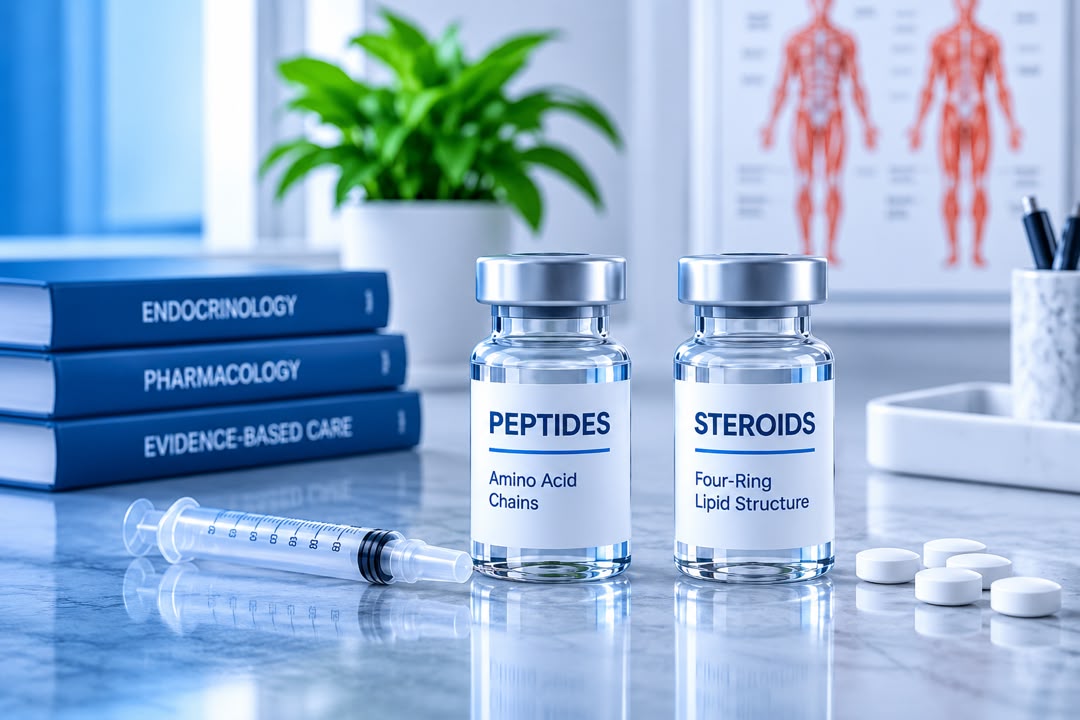
| Chemical structure | Chains of amino acids | Four-ring lipid structure |
| How they work | Signal cells via surface receptors | Enter cells and change gene activity |
| Typical form | Mostly injected (some oral or nasal) | Oral or injected |
| Muscle-building effect | Usually indirect and modest | Direct and strong |
| US legal status | Varies: approved drugs, compounded drugs or unapproved | Schedule III controlled substances |
| Banned in sport? | Many are (WADA) | Yes |
Are peptides legal like steroids?
They’re regulated differently:
- Anabolic steroids are Schedule III controlled substances under federal law. Possessing them without a prescription is a crime.
- Peptides aren’t controlled substances. They’re regulated as drugs (approved or compounded) or supplements (collagen). Injectable peptides still require a prescription to buy legally.
Under an October 2026 HHS policy, licensed pharmacies can compound BPC-157, TB-500 and four other peptides with a prescription. That still doesn’t make them FDA approved.
Some peptides affect hormones
“Not a steroid” doesn’t mean “no hormonal effects.”
- Growth-hormone secretagogues (ipamorelin, CJC-1295, sermorelin, GHRP-6) prompt your pituitary gland to release more growth hormone.
- Gonadorelin and kisspeptin influence testosterone production.
- GLP-1 peptides affect insulin and appetite hormones.
These effects are why some peptides are used alongside or instead of steroids in bodybuilding, and why they’re monitored in sport.
Are peptides banned in sports?
Many are. The World Anti-Doping Agency (WADA) bans:
- BPC-157, under “non-approved substances,” since 2022
- Growth-hormone-releasing peptides like ipamorelin, CJC-1295 and GHRPs
- TB-500 and other thymosin beta-4 fragments
A prescription doesn’t exempt tested athletes.
Are peptides safer than steroids?
It depends on the peptide. Anabolic steroids have well-documented risks, including liver strain, heart and cholesterol problems, hormone shutdown and mood changes. Some peptides seem to have milder side effects, but many have far less human research, so their long-term safety simply isn’t known. “Less studied” isn’t the same as “safer.”
FAQ
Is BPC-157 a steroid?
No. It’s a 15-amino-acid peptide.
Do peptides build muscle like steroids?
Not directly. Growth-hormone peptides may have modest effects on body composition, far weaker than anabolic steroids.
Will peptides show up on a drug test?
Standard employment drug tests don’t screen for them. Anti-doping tests can detect many banned peptides.
Is insulin a peptide or a steroid?
A peptide.
The bottom line
Peptides aren’t steroids. They’re amino acid chains that signal cells, while steroids are fat-based molecules that change gene activity. But some peptides still affect hormones and are banned in sport, so they deserve the same caution and medical oversight.